





When you really love someone, you love them completely, naturally accepting all flaws and imperfections. It is more than the passion and magic that goes with the act of falling in love. This kind of love accepts someone as they truly are, even with all the quirks, funny habits, and things that drive you crazy.
This is the kind of love that is the foundation for a lasting relationship. One that can last a lifetime.
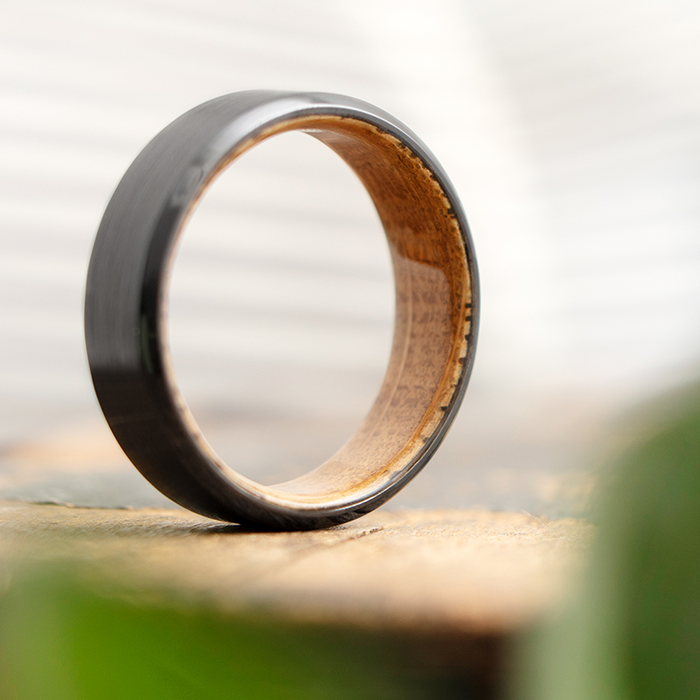
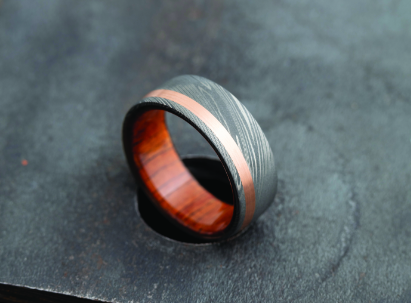
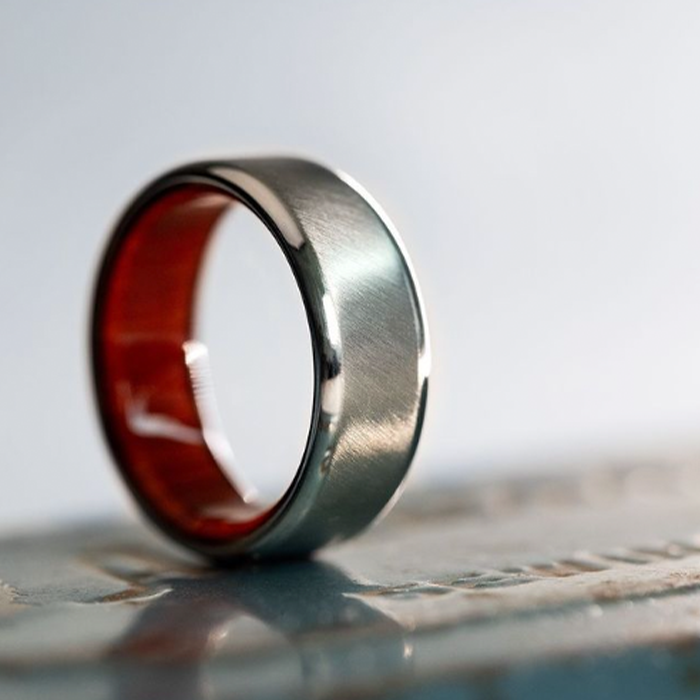
The juxtaposition of loving someone for both inherent beauty and imperfection perfectly represents a hardwood wedding ring. The wood in these rings are natural, rare, imperfect and beautiful, as is the love shared in marriage. The variation in color, character, pattern and quality of the woods make every ring unique, with no two pieces alike.
Material Guide

Our Custom Designs


Where is it from?
We use ethically sourced hardwood for wood rings. We buy hardwood only through reputable channels to support the sustainability of hardwoods and to avoid the illegal exporting of protected species. While very rare, the hardwoods used in our rings come from secured and sustained supplies or are reclaimed for some of our more storied pieces.
The Woods
The wood species represent 27 of the most beautiful, rare, and exotic hardwoods available in the world, coming from a variety of countries and representing nearly every major region of the world.
We have three types of woods: normal grained, burl woods, and spalted varieties. Normal grained woods are regular grains with some figuring and slight variation. Burl woods have deformed grains with small knots and dormant buds. Spalted woods feature unique black streaks along the grain.

Blood Wood

Bocote

Boxelder Burl

Cocobolo

Desert Iron Wood

Ebony

KOA

Leopard Wood

Madagascar Rose Wood

Maple Burl

Natural Oak

Osage Orange

Padauk

Pernambuco

Pyinma Burl

Red Heart

Sapele

Ancient Sequoia

Snake Wood

Spalted Tamarind

Teak

Thuya Burl

Walnut

Wenge

Whiskey Barrel

Ziricote
BLOODWOOD — SOUTH AMERICA
Bloodwood is an extremely dense and brittle, red colored wood from Venezuela, Peru, Panama, and Brazil. It is used to make trim, furniture, and turned objects. It has grown in popularity for wood workers despite being challenging to work with
BOCOTE — MEXICO
Bocote is an exotic wood native to Mexico. It features a wide range of grain patterns with striking, zebra-like contrasts of almost black stripes. The color ranges from golden brown to tan to golden yellow. It is a hardy, heavy and dense wood.
BOXELDER BURL — NORTHERN UTAH, USA
A white burled wood featuring a highly figured grain pattern. This species of tree is most commonly known for its characteristic pale white color. It is most often used for hobby work, small projects, pen blanks and as a base for dyed wood. This wood is soft but durable and very lightweight.
COCOBOLO — MEXICO
The color in Cocobolo varies from light yellow highlights to dark brown, with the most popular color being a red-orange brown. This wood is hard, heavy and very dense – it too, is one of the few species of wood that will sink in water. It’s natural oils help protect the wood from rot and insect attack, making it a popular wood to use for grips on pistols and musical instruments. It is becoming more rare and is now a protected species, making it a limited supply item.
DESERT IRONWOOD — ARIZONA, USA AND MEXICO
Desert Ironwood is a very rare tree, only growing in the Sonoran Desert, with a very attractive grain pattern, good contrast and some figuring. It is highly sought after amongst craftsman for small turning projects. This wood is very hard and dense – so dense, in fact, it is among the few species that sink in water.
EBONY — INDONESIA
Ebony is dark brown with black stripes, and is found as posts in many traditional Japanese homes. This wood has a high density which makes it harder to work with but great for small turned objects.
KOA WOOD — HAWAII, USA
Koa Wood has great variation in color, but is usually between a medium brown to a red brown, almost always with contrasting dark streaks. The wood comes from a flowering tree on the Hawaiian Islands, and it was traditionally used to build canoes, surfboards and body boards. It has since been recognized as a tone wood, used in instruments from ukuleles to acoustic guitars.
LEOPARD WOOD — CENTRAL AND SOUTH AMERICA
Leopard Wood has a unique spotted pattern, resembling the pattern on a leopard’s fur. The color varies from brown to red-brown with unique spots of light brown to grey. This wood is very dense and hard.
MADAGASCAR ROSEWOOD — MADAGASCAR
This wood is only found on the island of Madagascar and is used in musical instruments and cabinetry. It’s color is dark with black streaks. Madagascar Rosewood is currently threatened by habitat loss.
MAPLE BURL — USA
Maple Burl is a rare growth of a common tree. It varies in color from honey brown to medium brown, and features a prized pattern of tight swirls in the grain. When polished, the wood has a slight sheen.
NATURAL OAK — EASTERN USA
Oak is commonly used to represent strength and endurance due to its high density. With around 90 species of oak in the United states, oak is often used to make banjos, barrels, cabinetry and furniture. It’s a favorite of wood workers due to its easiness to work with.
OSAGE ORANGE WOOD — ARGENTINA AND USA
Argentine Osage Orange is very hard, dense, and characteristically yellow-orange in color. As part of a national project in the 1930’s, Osage Orange was planted as wind breaks in the plain states. We use the Argentine variety for its lighter but still bright yellow color.
PADAUK WOOD — AFRICA
Padauk wood color varies from bright, vivid orange to deep, orange-red. Regardless of the initial color, Padauk will fade in color over time. The jewelry grade sealant we uses will slow the aging process, but the wood will eventually fade to a warm, slightly red-brown color. Historically, Paduak served as an herbal medicine for treating skin and fungal infections. Today it is a favorite wood amongst wood turners, hobbyists and guitar makers.
PERNAMBUCO — BRAZIL
Pernambuco is the national tree of Brazil. This beautiful orange-red colored wood is often used to make bows for violins. Discovered in the 16th century by Portugese explorers, Pernambuco was heavily traded throughout Europe for production of a red dye preferred by high end textile manufacturers.
PYINMA BURL — SOUTHEAST ASIA
This wood has a tight and wavy grain pattern, with a golden to reddish brown color. The tightly patterned wood is used to make pool cues, pens, knife handles, and bowls, while the less patterned material is used in flooring, furniture, and boat building.
RED HEART — HONDURAS
A bright red hardwood with variations of lighter pink-red, watermelon red, and darker brown-red. In either case, the color will eventually fade to a darker, more reddish-brown color.
SAPELE — AFRICA
Sapele is a dark reddish brown color. The demand for Sapele has increased due to it’s use as a substitute for Mahogany. This wood is often used to make ukuleles, boats, flooring, and furniture.
ANCIENT SEQUOIA — SIERRA NEVADA MOUNTAINS OF CALIFORNIA
Giant sequoias are the world’s tallest tree species, with record trees measuring over 300’ tall. John Muir wrote fondly of the Sequoia, saying, “Do behold the King in his glory, King sequoia!” Giant sequoias are among the oldest living organisms on Earth.
SNAKEWOOD — CENTRAL AND SOUTH AMERICA
Snakewood is a reddish brown color with dark brown patches resembling snake skin. It is used to make violin bows and tool handles and is extremely dense.
SPALTED TAMARIND — AFRICA
Spalted Tamarind is a pale-yellow color with black streaks throughout the wood veins. The Tamarind tree is known for its fruit, which produces a sweet/sour flavored pod used extensively in world cuisine.
TEAK — SOUTHEAST ASIA, INDIA, INDONESIA, MALAYSIA, THAILAND, AND BURMA
Teaks grows in tropical regions, creating a lovely golden to medium brown wood. Teak can be found in furniture, cutting boards, and countertops. Archeological digs have unearthed boats over 2,000 years old, built using teak, and it is still in use building boats today.
THUYA BURL — MOROCCO, ALGERIA, TUNISIA, AND SPAIN
Thuya Burl varies in color from orange to red-brown, with many tightly arranged ‘eyes’. It grows from knot clusters of the roots of the Thuya tree. The Thuya tree is a small tree that has the ability to regrow itself from a stump, giving it the ability to regenerate after wildfire. We are currently phasing this wood out from our selection as the supply is too limited and rare, making it a limited supply item.
WALNUT — USA
Native to southwest Asia but now commonly grown all across America, England and other countries, this tree’s fruit was traded along the Silk Road and is one of the oldest trees in recorded history. Walnut wood’s grain is usually straight, but can be irregular. Its color ranges from a lighter pale brown to a dark chocolate brown with darker brown streaks.
WENGE WOOD — AFRICA
Wenge Wood is a dark brown wood with unique black streaks in the wood grain. It’s distinctive dark color marks, consistent pattern, and hardness makes it ideal for furniture and luxury wood paneling. It’s also used in high-end drums and other musical instruments.
WHISKEY BARREL — USA
Available in response to popular demand, this wood is known for its part in creating fine whiskey. Made using American White Oak wood, Jack Daniel’s* master craftsman handmake the barrels to age and mature whiskey. The barrels are only used once before being sold for myriad other purposes.
ZIRICOTE — BELIZE, GUATEMALA, AND MEXICO
This medium to dark brown wood with black streaking has a unique spiderweb look. Ziricote is used in musical instruments and cabinetry. Bark of the ziricote tree is used to make syrups for cough medicine, and the tree produces fruit eaten as a dessert or preserves in the Yucatan Peninsula.


Unique Characteristics
Each piece of hardwood varies slightly in character, color, and grain pattern, ensuring every wood ring is truly one of a kind. Wood’s raw, organic nature and inherent beauty is both rustic and refined. Its rich origin and exclusive markings speak to its distinctness amongst traditional metal wedding bands.
Technical Details
A hardwood ring begins as a solid block of hardwood. Our skilled artisans cut circles from the solid block and then secure it to the ring. After it’s been secured, the hardwood is sanded, polished and sealed with a medical grade resin.
This layer of resin protects hardwood rings from moisture and water damage, and scratching. It also acts as an insulator to the hardwood, protecting it from cracking in daily wear.
In the case of the resin being scratched, we stand ready to refinish the ring (refurbishment).
CUSTOMIZATION & PERSONALIZATION
Hardwood is available as an inlay or sleeve in any metal, either contemporary or precious. Wood inlays start at 3mm, as anything smaller than this would be both too brittle and too small to highlight the wood. Wood sleeves are now available on basic styles, rings with carvings and rings with precious metal inlays. Choose from any one of our popular styles or design your own hardwood ring with our Lashbrook Builder.
WEAR & CARE
Inlays and sleeves are protected from water and wear with a resin layer, which seals the wood from moisture. However, it is recommended to avoid prolonged exposure to water and chemicals and these rings should be removed during harsh activities or in environments that would be potentially damaging to the wood. The delicate nature of natural wood means taking extra care in choosing when to wear your wood ring to protect it well.
Cleaning: Hardwood rings can be polished to return the hardwood to its original beauty. We can factory refurbish these rings (refurbishment).
FAQs
Why doesn’t the pattern of the wood look like the website preview or Lashbrook Builder image?
How may types of wood does Lashbrook have to choose from?
Can you use wood I have sourced from my yard?
